
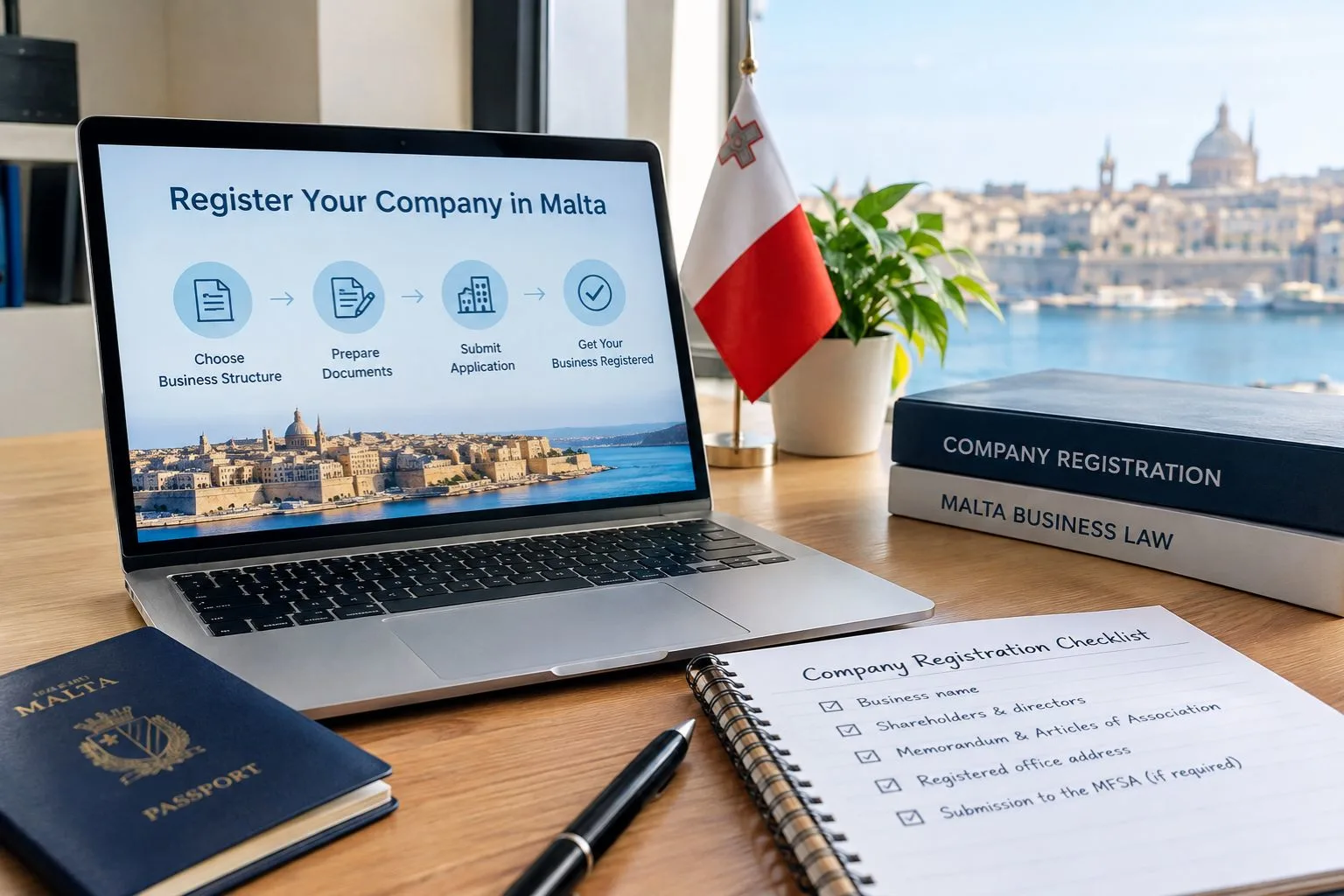
Reserve your name, draft the Memorandum and Articles, deposit your share capital, file with the Malta Business Registry, then register for tax and VAT. Most founders finish within two to three weeks.
“Did you know?According to the U.S Department of State, when setting up a Maltese private company, the minimum share capital amount accepted is €1,165. The minimum for a public company is approximately €46,600, of which 25 per cent must be deposited before registration.“
That’s one of the lowest entry costs in the EU. This guide walks through how to register a company in Malta, from choosing a name to opening your first bank account, and covers the full Malta company formation process so you’re not left guessing which form comes next.
Key Takeaways
- Malta companies require a registered office; a company must be able to supply the details of a registered office secretary, director and shareholder.
- The opening of a corporate bank account usually takes more time than incorporation, as banks generally conduct extensive due diligence checks.
- Through the Maltese offshore structure, foreign business people may fully own a Maltese company without needing local shareholders, directors, or business partners.
- Getting help with these processes is a great idea, as it can make all the paperwork and the various administrative tasks easier. The incorporation process also becomes a lot easier if you have professional help.
- Planning your documents and registrations early helps prevent unnecessary delays, penalties, and administrative complications later.
Why Founders Keep Choosing Malta
Malta lies inside the EU, so your company gets full access to the single market from day one. Starting a business in Malta also means a competitive corporate tax structure, English as an official language, and a legal system built on UK-style company law. It’s familiar territory, even if you’ve never set foot on the island.
Foreign founders can own 100% of a Maltese company. No local partner, no Maltese director required. That’s why Malta draws consultants, holding companies, Gaming operators, and fintech founders in roughly equal numbers.
Company Registration Requirements in Malta: What You Need First
Before you file anything, meet these company registration requirements in Malta set for every private limited company:
- At least one director (any nationality, no residency needed)
- One company secretary to manage compliance duties
- A minimum of one shareholder, up to a maximum of 50
- A registered office address physically located in Malta
- Minimum share capital of €1,165, with 20% paid up on registration
Public companies play by stricter rules. They need roughly €46,588 in minimum share capital, 25% paid up, and at least two directors.
Documents Needed to Register a Company in Malta
Here’s what you’ll need ready before you approach the registry. Missing even one of these documents needed to register a company in Malta can stall your application for days:
- Certified copies of passports for all directors and shareholders
- Proof of residential address, such as a recent utility bill
- A signed Memorandum and Articles of Association
- Bank confirmation of the deposited share capital
- A beneficial ownership declaration for anyone holding over 25% control
- Proof of the registered office address in Malta
Prepare every document before you submit your application, not halfway through. It saves everyone a headache.
Step by Step Malta Company Formation Process

Here’s the full sequence, in the order the Malta Business Registry (MBR) actually expects it.
Step 1: Reserve Your Company Name
Submit two or three name options to the MBR. The name has to be unique and not misleading. Expect one to two working days here.
Step 2: Draft the Memorandum and Articles of Association
Such company documents as memorandum and articles of association contain a company’s objectives, share capital structure, and regulations. A local company formation agent can help you with the preparation in no time, while making sure that everything is well-written and clear.
Step 3: Deposit the Share Capital
Open a temporary bank account and deposit your share capital of 20% at a minimum. The bank confirms the transaction and prepares a letter that you need to pass on to the MBR.
Step 4: Submit Your Application to the MBR
File the Memorandum, Articles, identification documents, and share capital confirmation. You can do this online or through an authorised agent.
Step 5: Receive Your Certificate of Registration
Once approved, the MBR issues a Certificate of Registration and a company number. That’s it; your company now legally exists.
Step 6: Register for Tax and VAT
Apply for a tax identification number with the Commissioner for Revenue. If your turnover will pass the VAT threshold, register for VAT at the same time.
Step 7: Open a Permanent Corporate Bank Account
Convert your temporary account into a full business account. This step often drags on the longest, thanks to bank due-diligence checks.
Malta Company Setup Timeline
Use this table to plan your Malta company setup timeline without any surprises.
| Stage | Typical Duration |
| Name reservation | 1–2 working days |
| Drafting Memorandum & Articles | 2–3 working days |
| Share capital deposit | 1–2 working days |
| MBR review and approval | 2–5 working days |
| Tax and VAT registration | 3–5 working days |
| Corporate bank account opening | 2–4 weeks |
Most founders complete incorporation itself within one to two weeks. The bank account is usually the slowest part, so get that process moving early.
Common Mistakes Founders Make
- Choosing a name too close to an existing brand: The MBR rejects these fast, no exceptions.
- Underestimating due diligence checks: Banks ask detailed questions about your business activity and source of funds.
- Skipping local advice on tax structure: Malta’s tax refund system is generous, but only when it’s set up correctly from day one.
- Delaying VAT registration: Late registration can trigger backdated penalties you didn’t see coming.
Working with an experienced local accountant helps you dodge every one of these.
What Does It Cost to Register a Company in Malta?
Government registration fees range from around €100 to €2,250, depending on your share capital and filing method. On top of that, add professional fees for drafting documents, a registered office, and company secretary services. Most founders budget between €1,500 and €3,500 for a full, professionally managed setup.
Register Your Malta Company the Right Way!
Starting a business in Malta doesn’t need to feel overwhelming, even if the paperwork looks intimidating at first glance. If you are considering how to register a company in Malta, get your documents right, follow the sequence above, and leave extra time for your bank account. Precision Point has guided founders through the entire process, from name reservation to tax registration, without the usual back-and-forth delays. If you’d rather hand off the Malta company formation process to someone who does this daily, our team can take the paperwork off your plate. Visit our website to book a consultation and get started this week.
Frequently Asked Questions
Q: How long does it take to register a company in Malta?
A: Incorporation itself usually takes one to two weeks once your documents are ready. Opening a corporate bank account can add another two to four weeks on top.
Q: Can a foreigner register a company in Malta?
A: Yes. Malta allows 100% foreign ownership, with no requirement for a local director or shareholder.
Q: What is the minimum share capital to register a company in Malta?
A: A private limited company needs €1,165 minimum share capital, with at least 20% paid up before registration.
Q: Do I need a physical office to register a company in Malta?
A: Yes, every company needs a registered office address in Malta, though a corporate service provider can supply this for you.
Q: What taxes will my new Malta company pay?
A: Malta’s standard corporate tax rate is 35%, but shareholders can often claim a tax refund that brings the effective rate down considerably, depending on structure.